MarCloud
Book a 30-minute fit check

Book a call to discuss:

  • Integrating 3rd-party platforms and implementation

  • Auditing data and segmentation in HubSpot and Salesforce

  • Underperforming journeys and automations

  • Reducing license costs and inefficiencies

  • Campaign attribution modelling and proving ROI

  • AI readiness, Agent POC's and Claude integration

In just 30 minutes, we'll know whether we're a mutual fit.

Marketing Cloud Next Advanced Edition Unpacked

If you already use Sales Cloud, Account Engagement, or Marketing Cloud Engagement, you may know this product as Marketing Cloud Advanced Edition. Salesforce now positions it as Marketing Cloud Next Advanced Edition, the higher of the two core-platform editions within Marketing Cloud Next. This guide explains what Advanced Edition includes, how it differs from Growth Edition, and how it fits alongside Salesforce’s existing marketing products.

3D eBook cover with text A Guide to Salesforce Marketing Tools
Free ResourceDownload now

Before we go further, it helps to clear up the naming. Marketing Cloud Next is Salesforce’s current name for its newer marketing platform built natively on the Salesforce core platform. Growth and Advanced are the two main editions of that platform. Marketing Cloud Engagement and Marketing Cloud Account Engagement remain separate products, although Salesforce now provides routes for customers to use Marketing Cloud Next capabilities alongside them through Engagement+ and Account Engagement+.

Many enterprise marketing directors and managers are in the same boat, seeking a solution for common challenges like:

• “How do we prove marketing ROI to the wider business?”

• “Our sales and marketing teams just aren’t on the same page.”

• “We’ve invested in automation, but it feels like we’re only scratching the surface of its capabilities.”

This guide is here to cut through the noise. We’ll explain what Marketing Cloud Next Advanced Edition brings to the table, who it’s for, and how it works within the Salesforce world to help businesses like yours. 

Along the way, we’ll highlight why being ‘on-core’ matters, how tools like Agentforce enhance Marketing Cloud Next Advanced, and why time and resource constraints shouldn’t hold you back.

The right choice depends on your existing Salesforce products, data architecture, channel requirements, and capacity to manage the platform properly.

What is Marketing Cloud Next Advanced Edition?

Marketing Cloud Next Advanced Edition is the higher tier of Salesforce’s on-core marketing platform. It includes all Marketing Cloud Next Growth Edition capabilities, then adds features for more advanced personalisation, experimentation, predictive scoring and two-way customer conversations.

The platform is built natively on Salesforce, uses Data 360 as its data foundation, Salesforce Flow for journey orchestration, and Agentforce for campaign planning and creation.

Its core capabilities include:

  • Connected data and workflows: Marketing, sales, service, and commerce teams can work with shared Salesforce data, permissions, and automation.

  • Multichannel journeys: Teams can orchestrate campaigns across email, SMS and WhatsApp, with SMS and WhatsApp requiring the relevant add-ons and messaging credits.

  • Advanced optimisation: Advanced Edition adds capabilities such as predictive scoring, predictive engagement frequency and Path Experiment.

  • Two-way conversations: Unified Conversations supports conversational engagement across SMS and WhatsApp, while Conversational Email is also available in Advanced Edition.

  • Scalable packaging: Advanced is designed for more complex campaign requirements than Growth, but usage still depends on messaging, Agentforce, and Data 360 credits.

  • UK data residency: Salesforce lists London as a local Data 360 residency region. Businesses should still confirm the residency of every connected Salesforce service and data flow against their regulatory requirements.

Who is Marketing Cloud Next Advanced Edition for?

Advanced Edition suits organisations that need the core capabilities of Growth Edition alongside more sophisticated optimisation, experimentation and conversational marketing features.

It is particularly relevant for:

  • Marketing teams that need predictive scoring, engagement-frequency modelling or Path Experiment.

  • Organisations running complex journeys across marketing, sales, service and commerce.

  • Businesses that need two-way SMS, WhatsApp or email conversations.

  • Teams managing multiple brands, regions or operating units, subject to Business Units licensing.

  • Account Engagement Plus, Advanced and Premium customers accessing Advanced Edition capabilities through Account Engagement+.

  • Marketing Cloud Engagement customers using a qualifying Engagement+ edition alongside their existing platform.

Advanced Edition is not automatically the next step for every Marketing Cloud Engagement customer. Engagement remains a separate enterprise platform with Journey Builder, Automation Studio, and established high-volume messaging capabilities. Salesforce’s current approach allows eligible customers to add Marketing Cloud Next alongside their existing products without rebuilding everything.

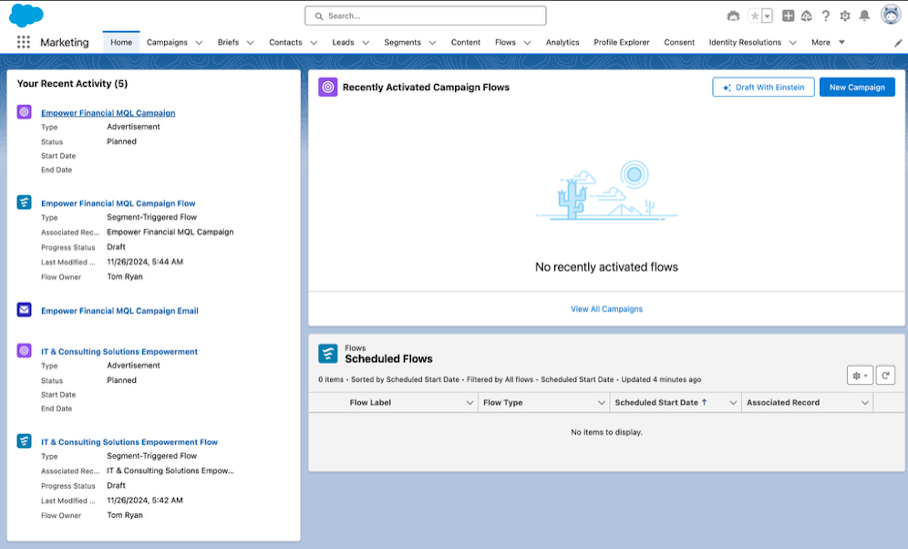
Screenshot of Marketing Cloud Advanced Home

For new Salesforce customers

New customers can purchase Marketing Cloud Next Growth or Advanced as their primary marketing platform. Before choosing an edition, confirm:

  • The channels and customer journeys you genuinely need.

  • The Salesforce CRM edition and permissions required.

  • Data 360 architecture, identity resolution and consent requirements.

  • Expected messaging, Data 360 and Agentforce credit consumption.

  • Internal ownership of campaigns, data, deliverability and reporting.

The builders and Agentforce features can reduce manual work, but implementation still requires sound data modelling, consent management, platform configuration and user training.

Of course, the easiest way to skip the learning curve and hit the ground running is to work with a certified Salesforce partner for implementation.

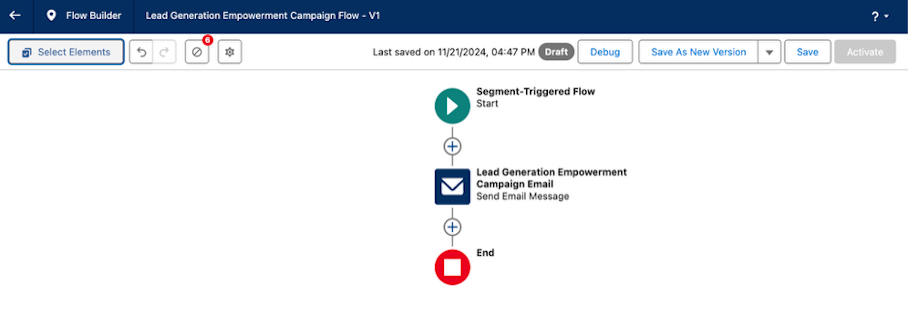
Screenshot of Marketing Cloud Advanced Flow Builder

For Account Engagement customers

Account Engagement customers can access Marketing Cloud Next capabilities through Account Engagement+ permission set licences. Salesforce currently maps the editions as follows:

  • Account Engagement Growth customers receive Marketing Cloud Next Growth Edition.

  • Account Engagement Plus, Advanced and Premium customers receive Marketing Cloud Next Advanced Edition.

Access does not mean that every feature is ready to use immediately or carries no additional cost. Data 360 must be provisioned and connected, permissions and content sharing must be configured, and customers may need additional Data 360, Einstein, SMS or WhatsApp credits.

Once configured, teams can use Account Engagement for established B2B lead generation and nurture while adding Marketing Cloud Next capabilities such as Agentforce Campaign Creation, cross-object personalisation, SMS, WhatsApp and Flow-based journeys.

Why being ‘on-core’ is always best

Marketing Cloud Next is built natively on the Salesforce core platform. It uses the same underlying security, metadata, permissions, and automation framework as other core Salesforce products.

This can reduce the number of integrations and synchronisation processes required between marketing and CRM. It does not remove the need for data architecture, connector configuration or governance, particularly when customer data sits across external systems.

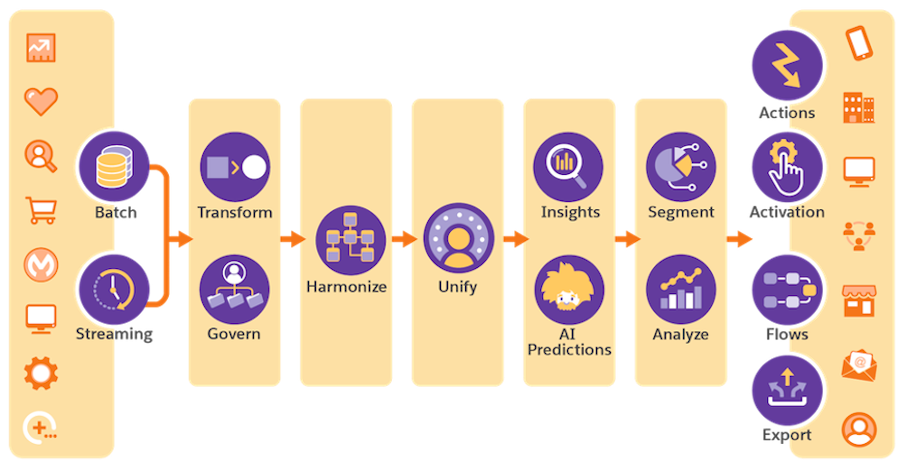
The power of unified data with Data 360

Data 360, formerly called Data Cloud, is native data activation engine and the data foundation for Marketing Cloud Next.

It can help teams:

  • Connect and harmonise data from Salesforce and external sources.

  • Create unified profiles where identity resolution is required.

  • Build segments using CRM, behavioural and transactional data.

  • Activate those audiences in campaigns and Salesforce workflows.

  • Give Agentforce approved customer and business context.

Real-time availability depends on the ingestion method, source system, and Data 360 architecture. Some data can support sub-second use cases, while other sources continue to update in batches.

Data Cloud process diagram

Agentforce: AI meets marketing automation

Agentforce supports generative and agentic work such as creating campaign briefs, audience segments, email and SMS content, and proposed customer journeys in Salesforce Flow.

Predictive capabilities such as Einstein Engagement Scoring, Predictive Scoring, and Predictive Engagement Frequency are separate Advanced Edition features.

Together, these tools can reduce campaign production time and improve decision-making, provided the underlying data, prompts, permissions, and review processes are set up correctly.

  • Customer journey optimisation: AI suggests the best path for each customer based on past interactions.

  • Content recommendations: Agentforce identifies what type of content is most likely to engage your audience.

  • Sales alignment: Predictive lead scoring helps sales teams prioritise the hottest leads.

When your marketing and data systems work together this seamlessly, it’s not just efficient; it’s revolutionary!

Comparisons with other Salesforce marketing tools

Let’s be super clear. Marketing Cloud Next Growth Edition and Marketing Cloud Next Advanced Edition are the same product - both built ‘on-core ’- they just have different levels of functionality. 

Marketing Cloud Engagement and Account Engagement, on the other hand, are separate products that were acquired by Salesforce over time and therefore are not built natively on the Salesforce platform.

However, Marketing Cloud Next Growth and Advanced features have been made available to Account Engagement customers.

That being said, let’s look at the key differences between features across each product.

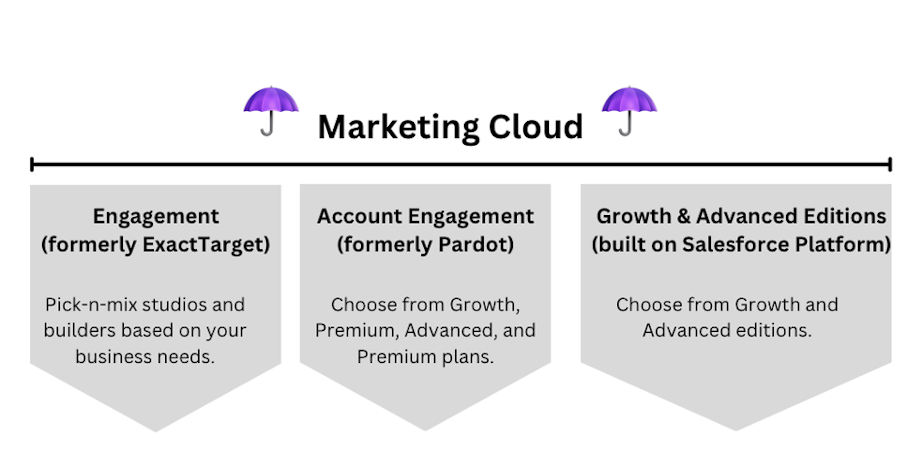
Marketing Cloud umbrella

Feature

Marketing Cloud Engagement

Marketing Cloud Account Engagement

Marketing Cloud Next Growth Edition

Marketing Cloud Next Advanced Edition

Real-time customer data

No (batch data only)

Limited (with Data 360 integration)

Limited (batch updates only)

Yes (supports real-time updates)

Omnichannel marketing

Email, social, digital ads, basic SMS, push

Primarily email

Email, basic SMS, supports multi-channel journeys

Email, SMS, social, digital ads, push

Analytics

Standard dashboards

B2B-specific analytics

Basic reporting

Enterprise-grade analytics

Lead scoring

No

Yes (robust lead scoring)

Engagement Scoring (basic)

Predictive lead scoring (AI-driven)

Segmentation

Moderate

Advanced (focused on B2B use cases)

Basic (limited criteria)

Advanced (real-time dynamic audiences)

Scalability

Medium to large businesses

Medium to large businesses

Small to medium businesses

Enterprise-level scalability

Sales alignment

Moderate tools for sales integration

Advanced tools (sales & marketing handoff)

Minimal tools for alignment

Advanced tools (unified marketing & sales)

Einstein AI capabilities

Moderate; includes some AI-driven insights

Moderate; primarily focused on lead scoring and campaign creation

Limited; basic engagement scoring

Comprehensive; advanced AI features including predictive analytics and personalisation

Integration with Data 360

Not available out of the box; requires custom API integration

Not available out of the box; requires custom API integration

Built on Data 360

Built on Data 360

Integration with Agentforce

Not available out of the box; requires custom API integration

Not available out of the box; requires custom API integration

Agentforce Campaign Creation

Fully integrated, offering advanced AI-driven insights and automation

Key takeaways

  • Growth and Advanced are editions of Marketing Cloud Next, rather than separate platforms.

  • Advanced includes all Growth capabilities, so features such as Data 360 integration and Agentforce Campaign Creation are not exclusive to Advanced.

  • Engagement remains the stronger fit for many established, high-volume Journey Builder and mobile messaging use cases.

  • Account Engagement remains focused on B2B lead generation, nurture, scoring, and sales alignment.

  • Existing Engagement and Account Engagement customers can add Marketing Cloud Next capabilities alongside their current setup. The precise route, entitlements, and credit costs depend on your edition.

Standout benefits of Marketing Cloud Next Advanced

Having worked with Salesforce systems for a decade, the team at MarCloud has been nerding out over the benefits Marketing Cloud Next Advanced brings to businesses.

Advanced Edition includes every Growth Edition capability. Some benefits below are therefore shared across both editions, while predictive optimisation, Path Experiment, and Unified Conversations are specific Advanced differentiators.

Here’s our pick of the most exciting:

1. Cross-object references

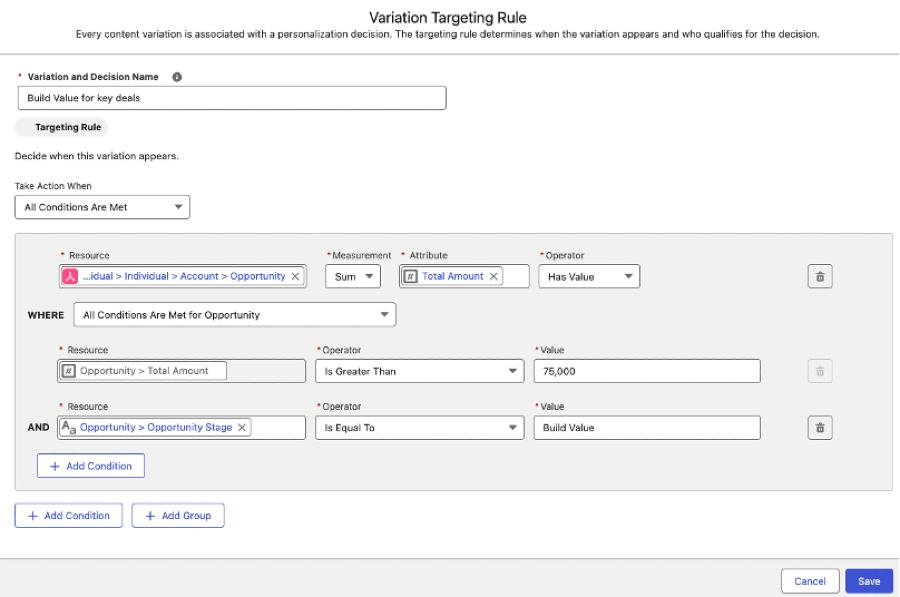
  • No more hacking data limitations, such as including Opportunities as merge fields in campaign content. Pull data directly from different Salesforce objects (e.g. Opportunities) using a data graph.

2. Unified conversations for SMS and WhatsApp

  • Advanced Edition supports two-way customer conversations across SMS and WhatsApp. Customers can respond to a campaign message, with the resulting conversation connected to the wider Salesforce customer record and routed into service workflows where required. SMS and WhatsApp require the relevant channel setup, add-ons, and messaging credits.

3. Dynamic content blocks

  • Personalise entire sections of content based on each customer’s data profile. Swap blocks of content based on a user’s interests or behaviour, and use multiple criteria.

Dynamic content blocks

4. Powered by Data 360

  • Campaign analytics, unified engagement history and Opportunity Influence reporting can connect marketing activity with CRM outcomes. The quality of this reporting still depends on consistent campaign architecture, opportunity data, contact relationships and an agreed attribution approach.

5. Flow-based journeys and Path Experiment

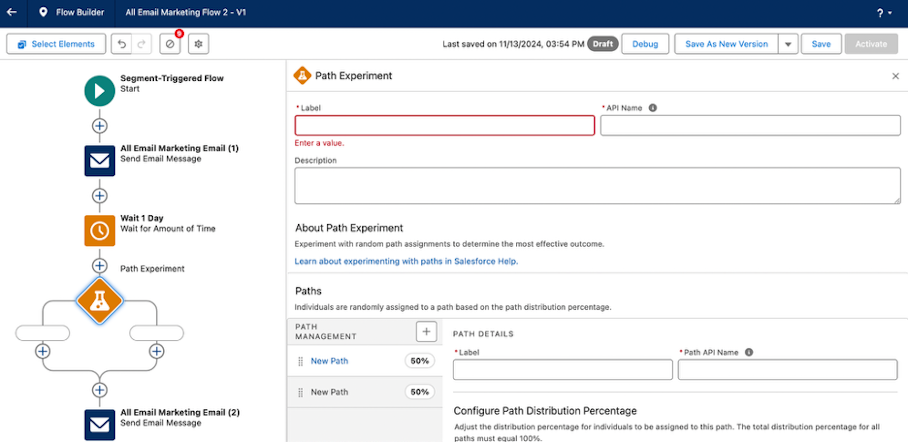
  • Build multistep journeys in Salesforce Flow and use Path Experiment to compare how different journey routes perform. Advanced Edition can test alternative paths and apply the resulting performance data to campaign optimisation.

Screenshot of Flow Builder

6. Channel preferences

  • If a customer prefers SMS over email, set up the path so they automatically receive an SMS. No manual intervention needed. You can even add a ‘wait’ step that listens for a response.

7. Conversational Email

  • Conversational Email allows recipients to reply directly to a marketing email and receive a contextual response from an Agentforce service agent. Conversations can be handed to a human service representative when the request needs further support. The feature is available in Marketing Cloud Next Advanced Edition, subject to Salesforce edition and setup requirements.

8. Business Units

  • Advanced Edition supports Business Units for organisations that need to separate users, data, content, campaigns, channels and reporting across brands, regions or operating teams. Business Units are listed as an add-on and require supported Salesforce editions, so packaging should be confirmed before implementation.

Implementation & integration tips

Implementing Marketing Cloud Advanced effectively requires a thoughtful approach. Its robust capabilities can transform your marketing operations, but setting it up correctly is crucial to unlocking its full potential.

1. Start with a clear data strategy

Marketing Cloud Advanced is as powerful as the data it uses. Begin by assessing your existing data:

  • Audit your data sources: Identify where customer data currently resides (CRM, website, email platform, etc.).

  • Cleanse your data: Remove duplicates and outdated information to ensure accurate, actionable insights.

  • Plan for Data Cloud integration: Map out how your data will flow between systems to enable real-time updates and unified customer profiles.

2. Align with your Salesforce stack

Maximise the benefits of Salesforce’s ‘on-core’ architecture by ensuring all your systems work in harmony:

  • Sales Cloud integration: Sync lead interactions between Sales Cloud and Marketing Cloud Advanced for better sales-marketing alignment.

  • Account Engagement (MCAE): Leverage MCAE for lead nurturing and Marketing Cloud Advanced features for multi-channel, enterprise-scale campaigns.

  • Agentforce integration: Use Agentforce’s AI capabilities for predictive lead scoring, content recommendations, and journey optimisation.

3. Lean on certified Salesforce Partners

Avoid reinventing the wheel by working with certified Salesforce partners, like MarCloud. Partners bring:

  • Expertise in implementation best practices.

  • Customised setups tailored to your business needs.

  • Training to ensure your team can use the platform effectively from day one.

4. Start small, then scale

While Marketing Cloud Advanced can handle enterprise-level operations, assuming you’re not working with a Salesforce Partner, it’s best to begin with a few smaller, simpler campaigns to:

  • Familiarise your team with the tools.

  • Test workflows and data connections.

  • Ensure everything runs smoothly before scaling to larger, more complex campaigns.

5. Train your team

Be sure to invest in training to empower your marketing team. Ensure they understand:

  • Campaign Flow for creating automated campaigns.

  • Reporting tools for tracking ROI and campaign performance.

  • How to leverage AI tools like Agentforce for optimisation.

Reporting on ROI

Proving marketing ROI can be a daunting task, but with Marketing Cloud Next Advanced, it becomes a lot more manageable. The platform is designed to provide enterprise-grade analytics and reporting tools that help you demonstrate the value of your marketing efforts.

It comes with:

  • Attribution models: Track which channels and campaigns drive conversions.

  • Real-time reporting: Monitor campaign performance as it happens.

  • Dashboards for stakeholders: Create visually compelling reports that speak to sales, finance, and leadership teams.

To get the most out of the reporting capabilities in Advanced Edition, remember to:

  • Set clear objectives and KPIs: Before launching any campaign, have a strategy and define success metrics. These might include lead-to-opportunity conversion rates, customer lifetime value, or revenue generated from specific channels.

  • Use attribution models: Multi-touch attribution helps you understand how different touchpoints contribute to conversions. Leverage the platform’s advanced analytics to track which channels, campaigns, and interactions drive the most value.

  • Automate reporting: Create automated reports tailored to stakeholders. For example, sales leaders might want insights into lead quality, while executives will appreciate a clear view of revenue impact. Custom dashboards in Marketing Cloud Next Advanced allow you to present data visually, making it easier for non-technical stakeholders to grasp.

  • Align with sales metrics: By integrating with Sales Cloud, you can track the full journey from marketing to sales, proving how marketing efforts contribute directly to revenue.

With the right setup, Marketing Cloud Next Advanced enables marketers to move beyond surface-level metrics and deliver data-driven, reliable insights that resonate with all levels of the business.

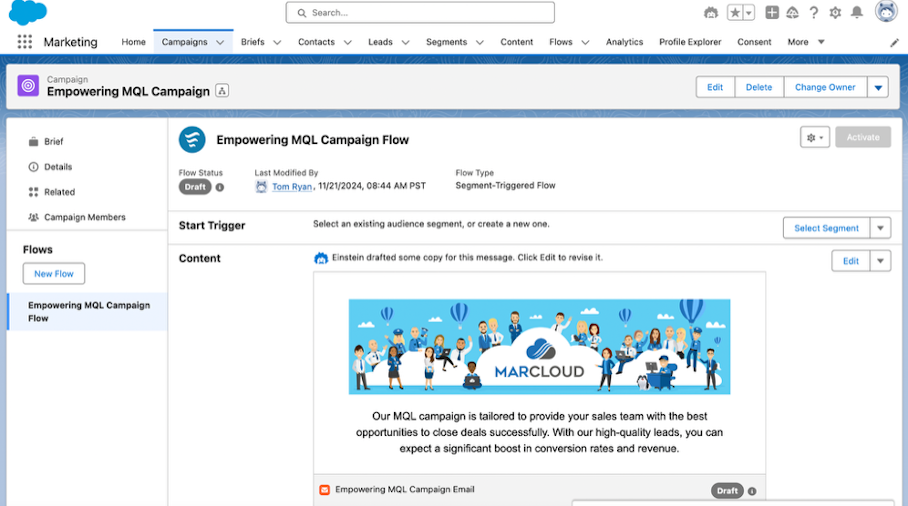
Screenshot of a campaign in Marketing Cloud Advanced

Planning around Salesforce’s Marketing Cloud roadmap

Marketing Cloud Next is where Salesforce is concentrating much of its on-core marketing development across Data 360, Salesforce Flow, and Agentforce.

This doesn't mean that Marketing Cloud Engagement or Account Engagement has become obsolete (at least, not yet). Salesforce’s current approach allows customers to use Marketing Cloud Next alongside those established products through Engagement+ and Account Engagement+.

A practical roadmap should include:

  • Preparing and governing the data that will be activated through Data 360.

  • Forecasting messaging, Data 360, and Agentforce credit consumption.

  • Piloting clearly defined campaigns before expanding into more complex journeys.

  • Building internal skills across Salesforce Flow, Data 360 and Agentforce.

  • Reviewing release notes and packaging regularly, as features and entitlements continue to change.

  • Measuring whether each new capability improves campaign performance, team efficiency or revenue reporting.

Marketing Cloud Next gives Salesforce customers a clearer route towards connected data, cross-department journeys and agent-supported campaign delivery. The business case still needs to rest on suitable use cases, realistic costs and measurable outcomes.

Alternatively, some Salesforce customers are migrating to HubSpot.

Get started sooner with expert support

MarCloud can help you assess whether Marketing Cloud Next Advanced, or a “+” route, is the right fit for your existing Salesforce setup. Or even compare Marketing Cloud Next with a migration to HubSpot. We support data and platform planning, implementation, integration, campaign configuration, reporting, and team training, so you can introduce the new capabilities or platform shifts with a clear business case and realistic view of licensing and consumption costs.

Book a call with a Marketing Cloud Next specialist.

Tom Ryan headshot

Tom Ryan

Founder & CEO of MarCloud, Tom has been on both sides of the fence, client-side and agency, working with Salesforce platforms for the best part of a decade. He's a Salesforce Marketing Champion and certified consultant who loves to co-host webinars and pen original guides and articles. A regular contributor to online business and marketing publications, he's passionate about marketing automation and, along with the team, is rapidly making MarCloud the go-to place for Marketing Cloud and Salesforce expertise. He unapologetically uses the terms Pardot, Account Engagement and MCAE interchangeably.

More by Tom Ryan

Featured resource

3D eBook cover with text A Guide to Salesforce Marketing Tools

Salesforce Marketing Tools

With the eBook ‘A Guide to Salesforce Marketing Tools’ in your arsenal, you’ll have a go-to, comprehensive, expert guide to understanding and selecting your perfect Salesforce marketing platform(s), be it Marketing Cloud Account Engagement (Pardot) or Engagement, and the products available to each.

Download now
View all resources

More recent posts

View all articles
Illustrated characters holding a MarCloud banner

Get expert Salesforce & HubSpot automation tips, straight to your inbox.

MarCloud is a team of certified Pardot, HubSpot, Marketing Cloud, and Salesforce specialists. We help businesses to unlock the potential of marketing automation. Join 2,000+ professionals who receive actionable insights to boost their automation performance.

Sign up to the newsletter

Free Guide to Salesforce Tools

With the eBook ‘A Guide to Salesforce Marketing Tools’ in your arsenal, you’ll have a go-to, comprehensive, expert guide to understanding and selecting your perfect Salesforce marketing platform(s).

Download now