MarCloudSpeak with a specialist
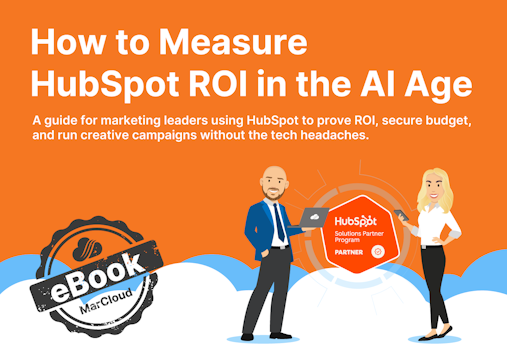
eBook cover with title How to Measure HubSpot ROI in the AI Age
Free ResourceDownload now

For marketers seeking unified reporting across hubs, custom integrations with the rest of your SaaS stack, advanced automation, and reporting that proves return on investment, out-of-the-box HubSpot isn’t enough.

At this point, in-house teams look for a HubSpot development specialist, a partner that extends, integrates, and governs the platform so it keeps up with your business needs.

To help you choose a HubSpot development agency, the guide below walks through when it’s worth bringing an agency in, how to evaluate the best partner, and how to think about ROI from your work together. 

The short version

A HubSpot development agency is a HubSpot-certified partner that designs, builds, and maintains custom functionality on the platform, ranging from custom modules and API integrations through to multi-hub data models and full RevOps implementations.

  • You typically need one when you are wrestling with multi-hub setups, custom modules, custom integrations, advanced workflow automation, multi-language marketing automation, complex sales pipelines, complex lead scoring, or end-to-end RevOps.

  • The strongest credibility signals are Diamond or Elite Solutions Partner status, HubSpot experience in custom integrations, data migrations, and solutions architecture, in-house senior developers, and published case studies.

  • Measure ROI on time-to-launch, admin hours recovered, pipeline velocity, MQL-to-SQL conversion, and HubSpot-attributed revenue.

MarCloud is a Diamond HubSpot Solutions Partner specialising in migrations and integrations. The Scott Logic HubSpot migration case study is a great example.

What is a HubSpot development agency?

A HubSpot development agency is a HubSpot-certified partner that designs, builds and maintains custom functionality on top of the standard HubSpot platform. The work spans custom modules for the CMS, API-level integrations with the rest of the business's SaaS stack, custom-coded workflow actions, CRM and data model configuration across multiple hubs, and the architectural decisions that keep everything running smoothly.

Some terms in this space get used interchangeably, and they really should not. A HubSpot marketing agency runs campaigns on top of the platform, a HubSpot onboarding partner gets you live for the first time, and a HubSpot development agency builds and extends the platform itself. The stronger agencies, MarCloud included, combine all three, delivering all of the services growing teams need.

When you need a HubSpot development agency

HubSpot is deliberately accessible to non-technical marketers, but needing development support is still common. Here are eight scenarios where in-house teams bring specialists in, and what a good HubSpot development agency can do in each case.

1. Multi-hub setups

Many businesses use HubSpot as a marketing-only tool, but as soon as Sales Hub, Service Hub and Operations Hub are bolted on, you’ll want to examine the underlying data model and how everything works together.

Lifecycle definitions have to be set across teams, properties can’t be created on a whim, and reporting across hubs has to be consistent, no matter who pulls it. If meetings keep ending with the question of whose numbers are right, you have a multi-hub architecture problem. 

A HubSpot development agency tackling a multi-hub setup will start with the data model, govern property creation and naming, and design reliable cross-hub reporting.

2. Custom modules for websites and landing pages

Native HubSpot modules cover the basics, and for a first website, they are usually enough. But later, when marketers need to publish twenty landing page variants for a product launch, personalise by segment, and keep the brand consistent, teams end up cloning pages, coding variants, and inheriting the maintenance debt for the following twelve months. 

A development agency solves this by building a library of reusable, brand-governed custom modules that non-technical marketers can drag, drop, and personalise. When evaluating agencies for this work, look for in-house developers rather than subcontracted freelancers, an example module library, and standards around performance and accessibility.

3. Custom integrations with your SaaS stack

Most native HubSpot integrations are designed to handle general use cases, which do the job until you need more. Whether it’s a HubSpot-to-Salesforce integration, Asana, Harvest, Aircall, or something else, the only way to report on the complete customer journey and show marketing attribution is through integration that aligns with how you store data and use the platforms.

Custom integrations are built using HubSpot's API with things like proper retry logic, rate limit handling, field conflict resolution, and monitoring that alerts you if something breaks. An agency promising a fully custom integration in a week shouldn’t be trusted. The best partners have a strategic discovery and mapping stage before any development work starts.

Read next: How to Choose the Right HubSpot Integration Partner

4. Advanced workflow automation

HubSpot workflows are straightforward to set up… until you try to run something particularly advanced. Branching logic, delays, nested conditions, and webhook steps can get messy and, in worst-case scenarios, end up admitting contacts into multiple workflows or sending them a barrage of emails.

Internally, sales teams might receive too many leads or the wrong leads altogether, causing them to stop trusting MQLs, or the marketing team spends a disproportionate amount of time debugging rather than building. 

A development agency will architect workflows with proper enrolment and suppression logic, a deep knowledge of the platform, and supporting documentation so that someone other than the original builder can maintain them. Development-first agencies tend to outperform marketing-first ones here, because they are used to thinking in systems before campaigns.

5. Multi-language and multi-region marketing automation

Expanding into new regions can see you hitting HubSpot's out-of-the-box limits quickly. 

Things like subscription types, legal copy, nurture journeys, ownership rules, and unsubscribe behaviour may all need to change by locale. And particularly in markets with strict consent regimes such as the EU and UK, the cost of getting it wrong is both reputational and legal.

An experienced HubSpot development agency will design locale-aware workflows, align subdomains and subscription types, and keep the whole structure documented so a new regional hire understands the setup. If you are planning to introduce new regions soon, it’s worth giving this side of things attention before the expansion.

6. Complex sales pipelines

New business, renewal, expansion, and partner deals rarely move through the same stages in the same order with the same fields, and forcing them to do so tends to produce a misleading forecast. 

The fix is a custom pipeline setup, with custom deal properties, required field mapping, stage automation, and forecasting that reflects how revenue comes in for your unique business. 

A HubSpot development agency working on this should be comfortable in Sales Hub and fluent in RevOps, not just configuring stages but translating the sales strategy into predictable pipeline automation.

7. Complex lead scoring

HubSpot lead scoring looks simple enough, but it can be difficult to get right because engagement signals vary, deal sizes can be large, and sales cycles are long. A too-basic or insufficient scoring model means sub-par MQLs and low close rates. 

A proper lead scoring strategy uses a multi-dimensional model covering fit, intent, engagement, and negative signals, validated against closed-won data, and layered with HubSpot's predictive and AI scoring

B2B HubSpot agencies worth considering here will have lead scoring knowledge with a real focus on conversion impact, they’ll be comfortable integrating with intent providers such as 6sense, Bombora, or G2, and they’ll push back on scoring assumptions.

8. End-to-end RevOps implementation

RevOps is an operating model, and HubSpot is well placed to support it because marketing, sales, and service can all run on the same record. What takes the project from dashboards to actual RevOps is the development layer underneath: a unified data model across hubs, SLAs encoded into workflows, a trusted ROI framework, and attribution reporting that reconciles to the finance team's numbers. 

Reaching this level of HubSpot implementation typically involves a HubSpot developer, a data engineer, and a RevOps role. If an agency is pitching end-to-end RevOps, it should involve far more than a one-person team.

What to look for in a HubSpot development agency

Being a certified HubSpot Partner is the obvious starting point, but Diamond or Elite Solutions Partners will have a standard of delivery that lower tiers may not. 

Beyond tier, consider whether the developers are in-house or subcontracted, whether you can speak with the consultant who will lead your project, and whether the agency has previously delivered in your industry. 

It goes without saying that published case studies with real numbers are worth more than a logo wall, and an agency that pushes back on your brief is actually a good sign! They’re thinking critically about what’s needed rather than nodding and only delivering what’s asked.

Many projects work in one of three shapes:

  • A fixed-scope build covers defined, one-off work such as migrations, theme builds or integration projects. 

  • A retainer covers ongoing development, portal health, workflow audits, integration monitoring, and advisory time, which tends to be underappreciated and also the thing that stops HubSpot portals from decaying and enables you to take advantage of new features right away.

  • A hybrid starts with a project and moves into a retainer once delivered.

How to hire a HubSpot agency for CRM migration

Migration is usually the highest-stakes HubSpot engagement a company commissions. A great HubSpot development agency will have a set process for migrations, and they’ll happily talk you through it.

  1. Define the end state first. Which hubs need to be live, which objects should be carried across, which integrations must work on day one, and which reports need to reconcile to the source system? Everything else in the project is downstream of this.

  2. Audit the old platform honestly. Salesforce, Dynamics, Pipedrive, and Zoho all accumulate years of custom fields, workflows, validation rules, and manual cleanup, and that context must be uncovered at the start rather than surfacing mid-project. A good development agency will include this in its step-by-step migration.

  3. Request a staged plan. A credible migration will run through discovery, data mapping, sandbox build, parallel running, cutover, and aftercare.

  4. Put the success metrics in the statement of work. Record-level accuracy, pipeline continuity, reporting parity, and time to first marketing send are good ones to track.

  5. Upskill and involve internal teams. Migrations frequently fail because users don’t understand the system; sales reps don’t trust the new pipeline stages, or the marketers don’t know where the workflows live. Training, playbooks, and documentation should be included as part of the project.

This Scott Logic HubSpot migration case study is a clear example of this approach in practice.

How to evaluate ROI from a HubSpot development agency

ROI on a HubSpot development project is a question every marketing leader will need to answer at some point.

Define the baseline before you start

How long does it currently take to launch a campaign from brief to live? How many hours a week does the marketing team spend on admin such as list building, integration checks, and reporting? What are your current MQL-to-SQL and SQL-to-closed-won conversion rates, and is the revenue currently attributed properly in HubSpot? None of these need to be perfect, but they should be accurate enough to compare against in six months.

The four levers a HubSpot development agency should move

  • Speed: Reduced time from brief to live campaign, page or workflow. 

  • Cost: Fewer admin hours, less tool sprawl and cleaner data. 

  • Revenue: higher conversion rates, a larger and faster-moving pipeline, and better alignment between marketing and sales. 

  • Risk: Fewer compliance incidents, fewer data-quality issues and more reliable forecasts. 

Reporting to the C-suite

The clearest ROI signal is that the exec team stops arguing about whose numbers are right. You have one executive dashboard, one source of truth, and the same definitions every quarter, and every HubSpot initiative ties back to a company priority rather than a marketing priority. This moves the conversation away from whether the marketing team is productive and into increased budget allocations.

Why MarCloud is a leading HubSpot development agency

MarCloud is a Diamond HubSpot Solutions Partner with a deliberate specialism in HubSpot migrations and integrations, including Salesforce, and bespoke stacks. 

The team is made up of in-house senior developers and consultants, not a network of freelancers. We have delivered across B2B, professional services and regulated industries, and we work in all three of the engagement models mentioned earlier, from fixed-scope builds through to ongoing development packages.

This Scott Logic HubSpot migration case study covers a complex professional services migration with integration and adoption work, but we can share more examples directly, too.

Remember, the agencies worth hiring are the ones that treat HubSpot development as a way of making marketing more profitable (and proving it!), and not as a set of technical tasks.

A 15-minute call is the fastest way to find out whether MarCloud is your best fit.

Tom Ryan headshot

Tom Ryan

Founder & CEO of MarCloud, Tom has been on both sides of the fence, client-side and agency, working with Salesforce platforms for the best part of a decade. He's a Salesforce Marketing Champion and certified consultant who loves to co-host webinars and pen original guides and articles. A regular contributor to online business and marketing publications, he's passionate about marketing automation and, along with the team, is rapidly making MarCloud the go-to place for Marketing Cloud and Salesforce expertise. He unapologetically uses the terms Pardot, Account Engagement and MCAE interchangeably.

More by Tom Ryan

Featured resource

eBook cover with title How to Measure HubSpot ROI in the AI Age

How to Measure HubSpot ROI

A guide for marketing leaders using HubSpot to prove ROI, secure budget, and run creative campaigns without the tech headaches.

Download now
View all resources

More recent posts

View all articles
Illustrated characters holding a MarCloud banner

Get expert Salesforce & HubSpot automation tips, straight to your inbox.

MarCloud is a team of certified Pardot, Marketing Cloud, and Salesforce specialists. We help businesses to unlock the potential of marketing automation. Join 2,000+ professionals who receive actionable insights to boost their automation performance.

Sign up to the newsletter

How to Measure HubSpot ROI

A guide for marketing leaders using HubSpot to prove ROI, secure budget, and run creative campaigns without the tech headaches.

Download now