What is Data Cloud?
Salesforce Data Cloud is a real-time data platform that collects and connects customer data from multiple sources, including CRM systems, websites, mobile apps, and marketing platforms. It combines this information into unified customer profiles that can be used across Salesforce products such as Sales Cloud, Service Cloud, Marketing Cloud, and Commerce Cloud. The goal of Data Cloud is to remove data silos so organisations can understand customer behaviour more clearly and deliver more relevant experiences.
Also known as:
• Data Cloud
• Salesforce CDP (earlier product name)
• Data 360
Not to be confused with:
• Marketing Cloud Intelligence
• Data warehouses or data lakes


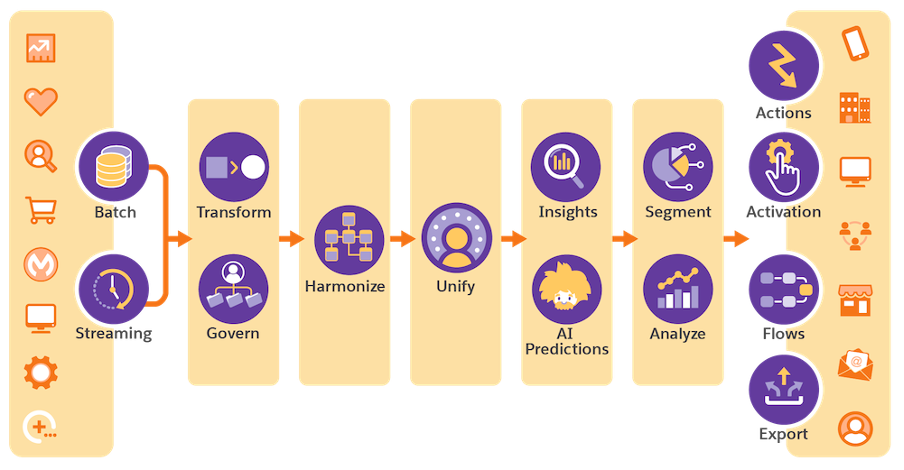
Businesses often store customer data across many different systems. Sales activity might live in a CRM platform, marketing interactions may sit in automation tools, and behavioural data might come from websites or mobile apps. And when these systems operate independently, it becomes difficult to form a complete picture of each customer.
Salesforce Data Cloud addresses this challenge by acting as a central data layer that connects and harmonises data across the organisation. By bringing these sources together, the platform creates a unified customer profile that updates continuously as new data arrives.
Because the platform is integrated with the wider Salesforce ecosystem, this unified data can then power marketing campaigns, service interactions, sales insights, and AI-driven recommendations.
Why Data Cloud?
Modern customer engagement depends heavily on data. Without a unified view of customers, teams often rely on incomplete information when making decisions.
Salesforce Data Cloud helps businesses:
combine customer data from multiple systems
build unified customer profiles across channels
support more personalised marketing and service experiences
enable real-time segmentation and insights
power AI-driven automation and analytics
improve collaboration between teams using the same data
Having a single source of truth for customer data makes it easier for different teams to work from consistent information.
How it works
Salesforce Data Cloud works by connecting, processing, and activating data from multiple sources.
A typical implementation involves:
Data ingestion – Import customer data from systems such as CRM platforms, websites, apps, and third-party tools
Identity resolution – Match data points belonging to the same customer across different systems
Data harmonisation – Standardise formats and structures so the information can be analysed consistently
Unified customer profiles – Create a single view of each customer
Segmentation and activation – Use the data to power marketing, service, and sales processes
Analytics and AI insights – Analyse data trends and support predictive capabilities
This process allows organisations to move from fragmented datasets to a consolidated understanding of customer behaviour.
Comparisons
Data Cloud vs traditional data warehouses
Data warehouses primarily store and analyse structured datasets for reporting.
Data Cloud goes further by unifying customer data and activating it across business applications, including marketing, sales, and service platforms.
Data Cloud vs Marketing Cloud Intelligence
Marketing Cloud Intelligence focuses on reporting and analytics for marketing performance.
Data Cloud focuses on collecting and unifying customer data so it can be used across the entire Salesforce ecosystem.
Data Cloud vs Customer Data Platforms (CDPs)
Salesforce Data Cloud is itself a customer data platform, designed to collect and unify customer data from multiple systems to support personalisation and analytics.
FAQs
What is Salesforce Data Cloud used for?
It is used to unify customer data from multiple systems so organisations can analyse behaviour and personalise customer experiences.
Is Data Cloud the same as Salesforce CDP?
Data Cloud evolved from Salesforce’s earlier customer data platform technology and now represents the broader data infrastructure within the Salesforce ecosystem.
Where does Data Cloud get its data from?
It can ingest data from CRM systems, marketing platforms, websites, mobile apps, data warehouses, and external data sources.
How does Data Cloud support personalisation?
By creating unified customer profiles, the platform allows organisations to segment audiences and tailor experiences based on real-time behaviour.
Does Data Cloud integrate with other Salesforce products?
Yes. Data Cloud connects with tools such as Sales Cloud, Service Cloud, Marketing Cloud, and Commerce Cloud so that customer data can be used across the platform.
Capabilities & More information
Capabilities of Salesforce
Common use cases include:
- Tools to unify data across multiple sources and systems
- Advanced segmentation to target specific customer groups
- AI-powered insights for predictive analytics and personalisation
- Real-time customer profiles for more accurate targeting
- Integration with Salesforce CRM for a complete customer view
- Ability to create lookalike audiences for targeted marketing
- Tools to manage consent and ensure compliance with privacy regulations
- Customisable dashboards for real-time data visualisation
Learn more about Salesforce
Resources and further reading...