What is Salesforce Sales Cloud?
Salesforce Sales Cloud is Salesforce’s flagship customer relationship management (CRM) product for managing sales processes, pipeline, accounts, contacts, leads, opportunities, forecasts, and revenue-related activity in a centralised cloud-based system. It provides tools to organise leads, convert them to opportunities, forecast revenue, and track every interaction that influences a deal. Built on the Salesforce Platform, Sales Cloud brings centralised data, automation, and visibility into a single place so teams can focus less on manual coordination and more on closing deals.
Also known as:
• Sales Cloud
• Salesforce CRM
• Salesforce Sales CRM
Not to be confused with:
• Salesforce (the broader ecosystem)
Salesforce Sales Cloud in context
For many organisations, Salesforce and Sales Cloud are used interchangeably, but there’s a difference. Salesforce is the broader ecosystem and company; Sales Cloud is the specific product tailored to sales teams.
Sales Cloud is designed to be the central system of record for sales activities. That includes capturing lead data from marketing sources, managing contact and account records, tracking the progress of opportunities through pipelines, and generating forecasts that help leadership understand future revenue.
For teams accustomed to spreadsheets, shared documents, and disconnected spreadsheets, moving to Sales Cloud brings one source of truth for all sales activity. Because it’s cloud-based, users can access the system from anywhere, whether on mobile in the field or on a laptop in a meeting.
Salesforce has baked in best practices from years of working with sales teams of all sizes, so core processes like lead conversion, task management, opportunity tracking, and performance dashboards are available out of the box, and extendable via automation and customisation.
Built on the flexible Salesforce Platform, Sales Cloud integrates smoothly with existing Salesforce systems, such as Marketing Cloud.


Why Sales Cloud?
Sales Cloud helps businesses organise, prioritise, and scale sales operations. Reps can:
Track leads and contacts in a structured sales process
Manage opportunity stages and action plans reliably
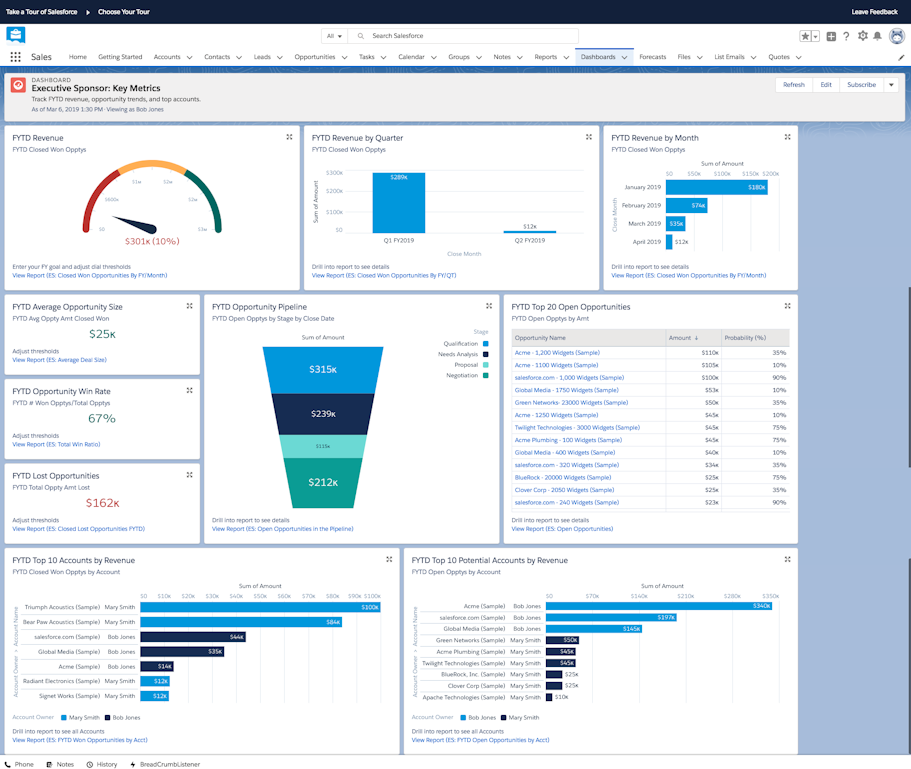
Forecast revenue with real-time dashboards
Automate repetitive tasks with workflows and automation
Collaborate across teams with shared visibility into deals
Access data from anywhere, on desktop or mobile
It’s the go-to platform for sales ops, revenue leaders, and reps who want clarity, consistency, and accountability in how deals are tracked and won.
How Sales Cloud works
Sales Cloud combines several functional pillars:
Leads & Contacts – Capture inbound interest and map it to organisations and people
Opportunities – Track potential deals, stages, probability, and close dates
Tasks & Activities – Log calls, emails, meetings, and to-dos to keep deals moving
Forecasting – Aggregate pipeline data for revenue projections
Reports & Dashboards – Visualise performance and monitor KPIs
Automation & Workflows – Use tools like Flow Builder to reduce manual work
All Sales Cloud objects share a common data model, meaning you can connect activities, accounts, and outcomes seamlessly, and avoid silos between team members or departments.
Comparisons
Sales Cloud vs Service Cloud
Sales Cloud is focused on revenue processes and pipeline management.
Service Cloud is focused on customer support and case management.
Sales Cloud vs Salesforce Platform
Sales Cloud is a CRM software delivering sales functionality.
Salesforce Platform is the technology foundation enabling custom apps, integrations, and automation across Salesforce products.
Sales Cloud vs CRM alternatives
Unlike spreadsheet-based tracking or generic CRM tools, Sales Cloud is designed to integrate deeply with marketing, service, and custom workflows, providing end-to-end visibility in a single system.
FAQs
Do I need Sales Cloud to use Salesforce products?
No, other Salesforce products, such as Service Cloud or Marketing Cloud Account Engagement, can be used without Sales Cloud CRM. But it's likely your sales and marketing activities will perform better with a fully integrated CRM, like Sales Cloud.
Can I customise Sales Cloud?
Yes. Sales Cloud can be tailored with custom fields, page layouts, workflows, and automation using tools like Flow Builder and the Salesforce Platform.
Does Sales Cloud support mobile use?
Yes, the Salesforce mobile app lets reps access accounts, update deals, and log activities on the go.
Can other teams use Sales Cloud data?
Yes, teams such as service, marketing, and leadership can access Sales Cloud data based on permissions and integrations.
Does Sales Cloud integrate with Slack?
Yes, with Sales Cloud for Slack, CRM context and actions can be surfaced directly in Slack channels for faster collaboration.
Capabilities & More information
Capabilities of Salesforce
Common use cases include:
- Lead and opportunity management – From first touch to close
- Pipeline visibility – See deals and stages clearly
- Activity tracking – Log interactions and follow-ups consistently
- Forecasting tools – Make data-informed revenue projections
- Mobile access – Work from anywhere with Salesforce mobile apps
- Customisable layouts & automation – Tailor Sales Cloud to your process
- Einstein AI insights - Improve sales results with AI recommendations
Learn more about Salesforce
Resources and further reading...