What is Marketing Cloud Connect?
Marketing Cloud Connect is a Salesforce integration that connects Marketing Cloud Engagement with Salesforce CRM systems, allowing data to move between platforms and enabling marketing teams to use CRM data for campaigns. By linking these environments, organisations can combine customer data stored in Salesforce with the communication capabilities of Marketing Cloud.


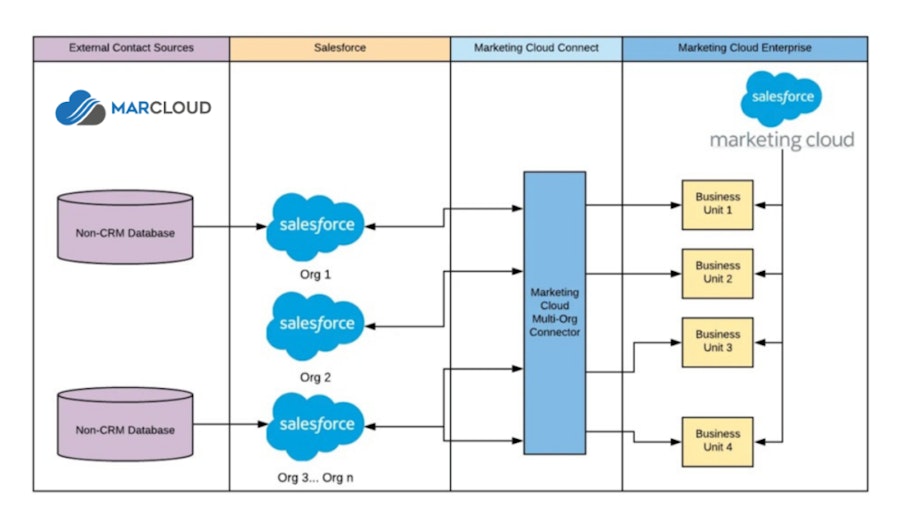
Marketing Cloud Connect in context
Salesforce CRM and Marketing Cloud often serve different functions within an organisation. CRM systems such as Sales Cloud or Service Cloud manage customer records, accounts, and sales activity, while Marketing Cloud focuses on customer communications and marketing automation.
Marketing Cloud Connect bridges these systems by enabling them to exchange information through API integration.
This connection allows marketers to access CRM data, such as leads, contacts, or opportunities, when building campaigns. At the same time, engagement data generated by marketing campaigns — including email opens or clicks — can be written back to Salesforce so sales and service teams can see how customers interact with marketing communications.
Why Marketing Cloud Connect?
When marketing and CRM systems operate independently, customer data can become fragmented across different platforms. Marketing Cloud Connect helps address this by allowing organisations to:
synchronise CRM data with Marketing Cloud audiences
use Salesforce customer records for campaign targeting
provide sales teams with visibility into marketing engagement
align marketing and sales activity using shared customer data
build more personalised marketing campaigns
With marketing and CRM systems connected, teams gain a more complete view of customer interactions across the organisation.
How it works
Marketing Cloud Connect links Salesforce CRM with Marketing Cloud using managed packages and APIs.
A typical integration process includes:
System connection – Salesforce CRM and Marketing Cloud accounts are linked through the connector
Data synchronisation – CRM objects such as Leads, Contacts, and Accounts are synced with Marketing Cloud data extensions
Campaign execution – Marketing teams create and send communications using CRM data
Engagement tracking – Campaign interaction data, such as opens and clicks, is captured
CRM updates – Engagement metrics are written back to Salesforce records
This bidirectional data flow allows both marketing and sales teams to access relevant customer information.
Comparisons
Marketing Cloud Connect vs Data Cloud
Marketing Cloud Connect synchronises data between Salesforce CRM and Marketing Cloud systems.
Data Cloud unifies customer data from multiple systems to create a centralised customer data platform.
Marketing Cloud Connect vs Marketing Cloud Intelligence
Marketing Cloud Connect enables data integration and synchronisation between platforms.
Marketing Cloud Intelligence focuses on marketing performance analytics and reporting.
Marketing Cloud Connect vs manual CRM data exports
Without integration tools, organisations often export CRM data manually to marketing systems.
Marketing Cloud Connect automates this process by keeping customer data synchronised across platforms.
FAQs
What is Marketing Cloud Connect used for?
It connects Salesforce CRM systems with Marketing Cloud so marketing teams can use CRM data for campaigns and share engagement insights with sales teams.
Which Salesforce products work with Marketing Cloud Connect?
The connector typically integrates Marketing Cloud Engagement with platforms such as Sales Cloud and Service Cloud.
What data can be synchronised using Marketing Cloud Connect?
Common objects include Leads, Contacts, Accounts, Campaigns, and other Salesforce records.
Can marketing engagement data appear in Salesforce CRM?
Yes. Engagement metrics such as email opens and clicks can be written back to CRM records.
Who typically uses Marketing Cloud Connect?
Marketing operations teams and Salesforce administrators are responsible for integrating marketing automation with CRM data.
Capabilities & More information
Capabilities of Salesforce
Common use cases include:
- Real-time data synchronisation between Marketing Cloud and Sales Cloud
- Tools to build personalised campaigns using CRM data
- Ability to create customer journeys based on CRM insights
- Automation tools for sending messages triggered by CRM updates
- Enhanced segmentation using CRM data
- Reporting tools
- Integration with Journey Builder
- Tools to track the impact of marketing efforts on sales outcomes