eBook cover with title Salesforce Marketing Cloud to HubSpot Migration Made Simple
Free ResourceDownload now

If you’re using Pardot (now known as Marketing Cloud Account Engagement) you might be questioning whether it still gives you what you need because the surrounding ecosystem has changed significantly. Salesforce platform names are different, new products have launched “on core”, and the roadmap has become harder to read from a marketing perspective.

At the same time, many teams are seeing peers move to HubSpot. Some are mid-migration already. Others are simply doing their homework, trying to understand what’s involved.

This article is for marketing managers and directors who need to protect future activities and budget, to run confident, creative campaigns without worrying about platform limitations or technical issues. Whether you’re actively planning a Pardot to HubSpot migration or just reviewing your options, here’s what you need to know.

Pardot to HubSpot migration: Quick summary

  • A Pardot to HubSpot migration is often driven by reporting complexity, platform uncertainty, and operational overhead.

  • Salesforce’s shift towards Marketing Cloud Growth and Advanced has created long-term questions for Account Engagement users.

  • HubSpot appeals to marketing teams looking for clearer ROI reporting, less technical dependency, and faster campaign execution.

  • Migration is not a simple data move; it requires rethinking data structure, automation, reporting, and CRM alignment.

  • For some organisations, optimising Pardot may still be the right decision.

The Salesforce Marketing Cloud landscape has changed

Pardot does not exist in the same context it did five or even three years ago.

Originally acquired by Salesforce and later renamed to Marketing Cloud Account Engagement, Pardot now sits within a broader and increasingly complex marketing ecosystem, now branded ‘Agentforce Marketing’. Alongside it, Salesforce has introduced platforms such as Marketing Cloud Growth and Marketing Cloud Advanced, both positioned as “on core” solutions.

From a product perspective, this has meant two things.

First, some core features have been incorporated into Account Engagement. On paper, this looks positive. In practice, it has blurred the line between what Pardot is meant to be versus where Salesforce is investing long-term.

Second, the direction of Pardot is less clear for day-to-day marketing teams. Will it be deprecated? Your guess is as good as ours. And for marketing leaders trying to plan twelve to twenty-four months ahead, such uncertainty is unnerving.

This isn’t a criticism of Salesforce’s strategy! It’s simply the reality marketers are facing.

Why marketing teams are reconsidering Pardot

Proving marketing ROI is taking too much effort

One of the most common concerns we hear is that end-to-end reporting is too difficult.

ROI reporting requires B2B Marketing Analytics (B2BMA) and Sales Cloud configuration, third-party tools, or manual workarounds. Attribution conversations can turn into debates about definitions rather than outcomes, so figures reaching the board are questionable.

With marketing leaders under pressure to prove business impact, reporting has to cover the full customer lifecycle, and it needs to be credible.

Marketing is still dependent on technical support

Many teams feel they are still bottlenecked by Salesforce admins or relying on external partners for relatively small changes in Pardot. Adjusting automation logic, troubleshooting sync issues, or setting up new campaign structures is harder than it should be.

As a result, marketers become cautious inside Pardot rather than creative.

Pardot platform direction feels uncertain

The launch of Marketing Cloud Growth and Marketing Cloud Advanced has raised fair questions. Will Account Engagement remain a priority? How much innovation will flow into it versus other platforms? What will licensing look like in the future?

Naturally, these questions have marketing leaders exploring alternatives.

Watch the webinar: Pardot vs HubSpot & Why Teams are Switching

Why HubSpot is a preferred alternative

HubSpot’s appeal is ease of use and marketing clarity. It has many similar features to Pardot, yet offers a more self-sufficient experience. Campaigns, automation, reporting, and CRM visibility are designed primarily for marketers rather than developers and specialists.

This doesn’t mean HubSpot is right for everyone, but marketing leaders considering a Pardot to HubSpot migration often point to three advantages.

Clearer reporting for senior stakeholders

HubSpot’s native reporting and attribution tools are designed to answer common commercial questions without heavy configuration. It’s easier to explain pipeline contribution, lead source performance, and campaign influence without caveats.

This supports more confident conversations with finance and leadership teams.

Less technical overhead

Automation, lifecycle stages, and workflow setup are generally easier to manage in-house, which reduces reliance on technical support for everyday activity and means teams can bring campaigns to market faster.

More freedom to experiment

In HubSpot, creative campaigns can be less stressful to launch because the system feels manageable and intuitive overall.

Area

Pardot (Account Engagement)

HubSpot

Reporting

Requires B2BMA and Salesforce setup

Native, marketer-friendly dashboards

Automations

Powerful but can be admin-dependent

Flexible and easy to do with right permissions

Campaign setup

Heavier configuration

Faster to launch and iterate

CRM dependency

Salesforce-centric

Built-in CRM with Salesforce sync

Typical migration driver

Complexity and uncertainty

Clarity and speed

When to consider a Pardot to HubSpot migration

A Pardot to HubSpot migration is the process of moving marketing data, automation, and reporting from Salesforce Marketing Cloud Account Engagement (Pardot) into HubSpot’s CRM and marketing platform, typically to improve reporting clarity, reduce technical overhead, and give marketing teams greater control over campaign execution.

It goes without saying that the decision to migrate from Pardot to HubSpot needs to be well-considered. From our experience planning martech strategy and managing migrations for businesses globally, a move to HubSpot often makes sense when:

  • Marketing ROI reporting lacks credibility or clarity.

  • Campaign execution feels slower than it should.

  • The team relies heavily on Salesforce or partner support for routine changes.

  • Budget conversations are becoming more defensive.

  • Marketing and sales alignment is difficult to maintain.

However, there are also cases where staying put is the right decision.

If your organisation relies heavily on custom Salesforce objects, complex sales processes, business units, or strict governance, Account Engagement may still be the better fit. In those situations, optimisation may deliver more value than migration.

Salesforce Marketing Cloud to HubSpot Migration Made Simple

Get your hands on the exact migration process MarCloud follows for Marketing Cloud and HubSpot, plus tips for integrating your new account with Salesforce CRM.

  • Preparing to migrate
  • Planning your MVP
  • Configuring HubSpot
  • Migration best practices
  • Expert tips and advice
  • Training & change management
HubSpot Migration eBook
eBook cover with title Salesforce Marketing Cloud to HubSpot Migration Made Simple

What’s involved in a Pardot to HubSpot migration?

Migration is often underestimated because it is described too simply. It is not just a data transfer or a ‘life and shift’ exercise. The main elements to consider include:

Data migration and structure

Core records such as contacts, companies, and leads can be migrated, but this is also the moment to review what should move.

Are all custom fields being used? Duplicate or unused data should be addressed rather than carried across. Consent and compliance rules must be sense-checked and mapped.

This is your opportunity to clean your database and ensure that your new HubSpot implementation is set up well from the start.

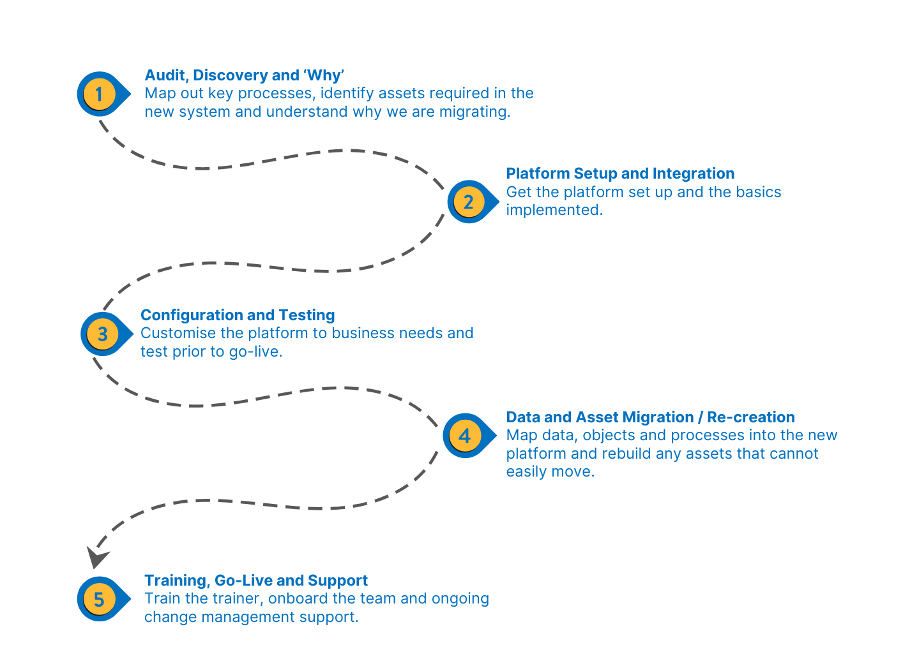
Graphic showing the five MarCloud migration phases

Automation and campaign rebuilds

Legacy logic that no longer serves a clear purpose can be removed. Campaign structures can be simplified. Lead management rules can be aligned more closely with how sales reps work. There are plenty of improvements that come hand-in-hand with a Pardot to HubSpot migration - just be sure to anticipate and document your plans first.

Salesforce integration

For teams continuing to use Salesforce as their CRM, the HubSpot–Salesforce integration becomes critical. Ownership rules, lifecycle stages, and HubSpot to Salesforce sync behaviour need to be clearly defined to avoid confusion later.

This is where many migrations succeed or fail, so it’s important to work with an expert.

Reporting on ROI after migration

One of the main reasons marketing leaders consider a Pardot to HubSpot migration is confidence. Confidence in numbers, in explanations, and in decisions.

Post-migration, reporting should feel far more credible.

Your HubSpot dashboards should answer the questions senior stakeholders ask, and Marketing and Sales should share a common language around sales-qualified leads, opportunities, and revenue.

If reporting improves but trust in the numbers does not, the migration has issues.

Common migration risks to avoid

Common migration pitfalls include:

  • Treating migration as a solely technical task rather than a strategic one.

  • Attempting to rebuild outdated processes and automations.

  • Underestimating internal change management.

  • Failing to redefine lead management and reporting early.

Avoiding these issues requires an audit of your current system, a written migration plan, and cross-team input.

Planning your migration

Before committing to a Pardot to HubSpot migration, marketing leaders should be able to answer a few simple questions.

What does success look like ninety days after launch? Which reports matter most to the board? What processes currently create frustration or doubt?

Migration works best when it is framed as a reset of internal processes and management.

Interested in a Pardot to HubSpot migration?

Marketing automation software decisions are rarely black and white, and timing can matter as much as your chosen tool. Whether you migrate now, later, or not at all, understanding your options and what’s involved keeps you informed and in control.

If you want an honest view of whether a Pardot to HubSpot migration makes sense for your business, MarCloud can help. We focus on helping you achieve tangible goals, not platform preference, so you can make decisions with confidence. Let’s talk!

Tom Ryan headshot

Tom Ryan

Founder & CEO of MarCloud, Tom has been on both sides of the fence, client-side and agency, working with Salesforce platforms for the best part of a decade. He's a Salesforce Marketing Champion and certified consultant who loves to co-host webinars and pen original guides and articles. A regular contributor to online business and marketing publications, he's passionate about marketing automation and, along with the team, is rapidly making MarCloud the go-to place for Marketing Cloud and Salesforce expertise. He unapologetically uses the terms Pardot, Account Engagement and MCAE interchangeably.

More by Tom Ryan

Featured resource

eBook cover with title Salesforce Marketing Cloud to HubSpot Migration Made Simple

Salesforce Marketing Cloud to HubSpot Migration

Get your hands on the exact migration process MarCloud follows for Marketing Cloud and HubSpot, plus tips for integrating your new account with Salesforce CRM.

Download now
View all resources

More recent posts

View all articles
Illustrated characters holding a MarCloud banner

Get expert Salesforce & HubSpot automation tips, straight to your inbox.

MarCloud is a team of certified Pardot, Marketing Cloud, and Salesforce specialists. We help businesses to unlock the potential of marketing automation. Join 2,000+ professionals who receive actionable insights to boost their automation performance.

Sign up to the newsletter

Salesforce Marketing Cloud to HubSpot Migration Made Simple

Get your hands on the exact migration process MarCloud follows for Marketing Cloud and HubSpot, plus tips for integrating your new account with Salesforce CRM.

Download now