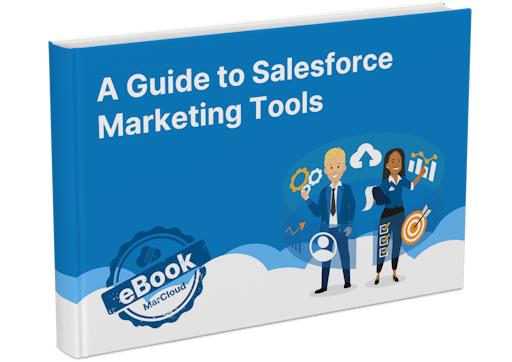
3D eBook cover with text A Guide to Salesforce Marketing Tools
Free ResourceDownload now

At MarCloud, we're hearing this more and more. Clients are asking whether it's time to migrate away from legacy Salesforce products, and increasingly, the conversation is about Marketing Cloud Next

Some clients are asking about HubSpot migration, too, and in some cases, a move to HubSpot is the right thing to do. But for teams already embedded in the Salesforce ecosystem, Marketing Cloud Next is an option worth understanding.

If (like so many others) you’re confused about another addition to Marketing Cloud (and another name to remember!), this article covers what Marketing Cloud Next is, what the Advanced Edition gives marketing leaders, and what a move can realistically look like.

What is Salesforce Marketing Cloud Next?

Marketing Cloud Next is Salesforce's next-generation marketing platform, announced at Connections in June 2025 and now generally available. It's built natively on the core Salesforce platform (unlike acquired platforms such as Pardot, aka Account Engagement), and it brings together Data Cloud, Agentforce AI agents, and a set of marketing tools (including Growth and Advanced editions) under one roof.

The name is deliberate. It's designed to signal a step forward for teams on older Salesforce marketing products, and Salesforce describes the move as a ‘hop’ rather than a full migration. 

Marketing Cloud Next includes two editions: Growth, which suits smaller businesses getting started with marketing automation, and Advanced, which is built for teams at scale. The latter is most relevant to anyone considering a move from Account Engagement or Marketing Cloud Engagement.

What’s exciting about it?

The underlying architecture is what sets Marketing Cloud Next apart. Previous products like Account Engagement (formerly Pardot) and Marketing Cloud Engagement (formerly ExactTarget) were built as separate systems and connected to Salesforce through integrations. Marketing Cloud Next is built on the same platform as Sales Cloud and Service Cloud, with Data Cloud at its foundation. That technical detail changes what’s possible, both now and as the platform continues to develop.

Free Guide to Salesforce Tools

With the eBook ‘A Guide to Salesforce Marketing Tools’ in your arsenal, you’ll have a go-to, comprehensive, expert guide to understanding and selecting your perfect Salesforce marketing platform(s).

  • The Salesforce ecosystem
  • Understanding Salesforce tools
  • Choosing your Salesforce tools
  • Implementation tips
  • Build your business case
  • Free quiz
Download A Guide to Salesforce Marketing Tools
3D eBook cover with text A Guide to Salesforce Marketing Tools

Salesforce's flagship marketing product

I’ll caveat the below by saying this is all opinion and conjecture based on our experience.

Account Engagement has not seen meaningful feature development in some time. The product still works, and for straightforward B2B nurture programs, it does the job, but the gap between what it can do and what marketing teams need to do has widened. 

Meanwhile, teams on Marketing Cloud Engagement have infamous limitations. The platform is powerful for high-volume email, but the user experience is poor, and the data infrastructure sits separately from Sales Cloud CRM, which creates challenges with reporting that make proving ROI difficult.

Marketing Cloud Next is where Salesforce's investment is going. Agentforce, Data Cloud, and the core Salesforce platform are the three pillars Salesforce has been building around, and Marketing Cloud Next sits at the intersection of all three. When you look at what's been announced at Dreamforce over the past couple of years, the direction is clear.

That doesn't mean the decision to move should be rushed. But it does mean it's worth taking the evaluation seriously now, before you're doing it reactively.

Growth vs. Advanced: Which one applies to you?

If you're evaluating Marketing Cloud Next as a migration from Account Engagement or Marketing Cloud Engagement, the Advanced Edition is the relevant starting point. Growth Edition is designed for smaller businesses building their marketing automation foundations, and while it includes Agentforce Campaign Creation and core channel support, it doesn't have the scale, customisation, or advanced segmentation that mid-market and enterprise teams need.

Advanced Edition includes everything in Growth, plus A/B testing, advanced segmentation, SMS, expanded Agentforce capabilities, and the full Data Cloud integration that makes the unified customer view possible.

Marketing Cloud Next Advanced capabilities

The features worth talking about here are the ones that solve major problems for marketing leaders: the pressure to prove ROI, the need to run campaigns without relying on developers, and the ability to show the C-suite a consistent picture of marketing performance.

Campaign creation without the production backlog

Agentforce Campaign Creation lets you describe what you want to achieve and generates a full campaign brief, audience segment, email and SMS content, and a campaign flow, ready for you to review and activate. It works from natural language prompts, so you're not writing SQL or building complex filters to define your audience.

Campaigns that previously took weeks to build can be turned around in days. For teams that are under-resourced or where technical resources are stretched, this is a big change.

A single view of the customer

One of the most common problems marketing leaders face when presenting to the C-suite is that the numbers don't match. Marketing is reporting one figure, sales is reporting another, and the meeting turns into a debate about data rather than a conversation about performance. Marketing Cloud Next, built on Data Cloud, gives every department access to the same customer profiles. The same data that informs your campaigns informs the reports your Sales Director sees.

This alignment is huge for budget conversations. When marketing's contribution to sales pipeline is visible in the same system that everyone else is working from, arguing for marketing investment is far easier.

Two-way conversations across channels

Traditional marketing platforms were built for broadcasting: you send, the recipient receives, and that's more or less where the interaction ends. Marketing Cloud Next is built on a different model, where AI agents can respond to customer behaviour and messages in real time across email, SMS, and WhatsApp. The era of the "do not reply" email is, as Salesforce puts it, over.

For marketing teams, this means campaigns can be interactive without requiring a team of people to manage the responses. For customers, the experience feels less like a broadcast and more like a conversation.

Dashboards and reporting out of the box

Marketing performance dashboards in Marketing Cloud Next give clear visibility into email deliverability and campaign performance across channels. Segment Intelligence lets you analyse audience performance by campaign, channel, and objective. You don't need a BI analyst to build these for you because they're part of the platform.

For anyone who has spent time exporting data from a legacy platform into a spreadsheet to produce a report for a board meeting, this can completely change the way you present.

Lead qualification that bridges the gap to sales

Agentforce Lead Management handles lead qualification autonomously by evaluating prospects, managing contact frequency, and routing qualified leads to the right salesperson, complete with their engagement history. It runs continuously, which means prospects are less likely to fall into the gap between marketing handoff and sales follow-up, and marketing gets credit for pipeline contribution rather than just top-of-funnel volume.

To move or migrate, that’s the question

Salesforce is deliberate about not calling the move from another Salesforce product to Marketing Cloud Next a ‘migration’. They call it a convergence. Your existing data, lists, and content in Account Engagement work alongside Marketing Cloud Next, so you don't rebuild from scratch. For teams on Marketing Cloud Engagement, there's a pathway via Marketing Cloud+ that lets you run the platforms in parallel before switching over fully.

However, what a well-managed move looks like is:

  • A full data audit

  • a review of your existing campaigns and automations

  • a phased activation plan 

The quality of your CRM data is crucial! Data Cloud is only powerful when the data going into it is reliable. It's always worth resolving data hygiene issues before you migrate.

MarCloud's experience is that teams who approach this as a considered project, rather than a quick switch, get significantly better results. Moving to a new platform is always an opportunity to simplify and improve what you already have, and it's worth taking that opportunity deliberately.

Is Marketing Cloud Next right for you?

You're in a good position to evaluate Marketing Cloud Next if you're using Account Engagement and hitting its ceiling, if your team is being asked to run more campaigns without more resources, or if your current reporting setup makes it difficult to demonstrate marketing's contribution to revenue. Let’s face it, that’s a lot of Salesforce marketers!

You might want to wait if your CRM data is in poor shape (or work with a Salesforce partner to get your database in order!), if your business doesn't have the capacity to manage a platform change right now (unless you have the budget to outsource), or if you're on Salesforce Professional Edition (Enterprise or higher is required for Marketing Cloud Next).

On the HubSpot question: for teams that aren't deeply committed to the Salesforce ecosystem, HubSpot is a legitimate alternative. It’s easy to use, and it has closed the gap on capability in several areas. But for organisations already running Salesforce CRM, Marketing Cloud Next's native data integration is a structural advantage. The unified customer view isn't something you can replicate with an integration, however well-built.

Recap: Your questions answered

What is Salesforce Marketing Cloud Next?

Marketing Cloud Next is Salesforce's next-generation marketing platform, built natively on the core Salesforce platform. It combines Data Cloud, Agentforce AI agents, and the Marketing Cloud Growth and Advanced editions into a single, unified system for agentic, cross-channel marketing.

What’s the difference between Growth and Advanced?

Marketing Cloud Next Growth Edition is designed for smaller businesses. Advanced Edition is built for scale, with full Data Cloud integration, advanced segmentation, SMS, A/B testing, and expanded Agentforce capabilities, making it the most suitable option for teams migrating from Account Engagement or Marketing Cloud Engagement.

Is Marketing Cloud Next replacing Account Engagement?

Not by force. Salesforce's position is convergence, not migration, and Account Engagement continues to be supported. However, the direction of investment and product development is clearly towards Marketing Cloud Next, and teams on Account Engagement can already access Next's features alongside their existing instance.

Do I need Data Cloud to use Marketing Cloud Next?

Yes. Data Cloud is the foundation of Marketing Cloud Next and a prerequisite for features including Agentforce, cross-object personalisation, and SMS.

Can I keep my existing data and assets when moving to MC Next?

Yes. Your data, lists, and content in Account Engagement work seamlessly across Marketing Cloud Next, so there's no need to rebuild from scratch.

What to do next

For teams on Account Engagement that have been waiting for the product to catch up, or for teams on Marketing Cloud Engagement managing a disconnected architecture and tech-heavy product, you should be weighing up a move to Marketing Cloud Next.

We help clients evaluate whether Marketing Cloud Next Advanced Edition is the right fit for their situation and, for those who are ready, we plan and manage the entire move. To talk through what it would look like for your team, get in touch.

Tom Ryan headshot

Tom Ryan

Founder & CEO of MarCloud, Tom has been on both sides of the fence, client-side and agency, working with Salesforce platforms for the best part of a decade. He's a Salesforce Marketing Champion and certified consultant who loves to co-host webinars and pen original guides and articles. A regular contributor to online business and marketing publications, he's passionate about marketing automation and, along with the team, is rapidly making MarCloud the go-to place for Marketing Cloud and Salesforce expertise. He unapologetically uses the terms Pardot, Account Engagement and MCAE interchangeably.

More by Tom Ryan

Featured resource

3D eBook cover with text A Guide to Salesforce Marketing Tools

Salesforce Marketing Tools

With the eBook ‘A Guide to Salesforce Marketing Tools’ in your arsenal, you’ll have a go-to, comprehensive, expert guide to understanding and selecting your perfect Salesforce marketing platform(s), be it Marketing Cloud Account Engagement (Pardot) or Engagement, and the products available to each.

Download now
View all resources

More recent posts

View all articles
Illustrated characters holding a MarCloud banner

Get expert Salesforce & HubSpot automation tips, straight to your inbox.

MarCloud is a team of certified Pardot, Marketing Cloud, and Salesforce specialists. We help businesses to unlock the potential of marketing automation. Join 2,000+ professionals who receive actionable insights to boost their automation performance.

Sign up to the newsletter

Free Guide to Salesforce Tools

With the eBook ‘A Guide to Salesforce Marketing Tools’ in your arsenal, you’ll have a go-to, comprehensive, expert guide to understanding and selecting your perfect Salesforce marketing platform(s).

Download now